All Courses
Community mediation is a form of alternative dispute resolution (ADR) that helps people resolve local or interpersonal conflicts outside of formal legal systems. It usually involves trained volunteers or professional mediators who guide conversations between parties to reach a voluntary, mutually agreeable solution. The process is informal, accessible, and often free or low-cost. Its purpose is to strengthen relationships and reduce the need for litigation or law enforcement involvement (National Association for Community Mediation).
Common issues handled through community mediation include neighbor disputes, tenant–landlord conflicts, roommate disagreements, business–customer problems, and conflicts within community groups. Some programs also address school issues, family disagreements, or juvenile diversion cases. Mediation is confidential and non-adversarial. Usually, two co-mediators guide the process, helping participants share concerns, clear up misunderstandings, and explore solutions. Agreements are not legally binding unless formalized, but they are often followed because the parties help design the terms themselves (Resolution Systems Institute).
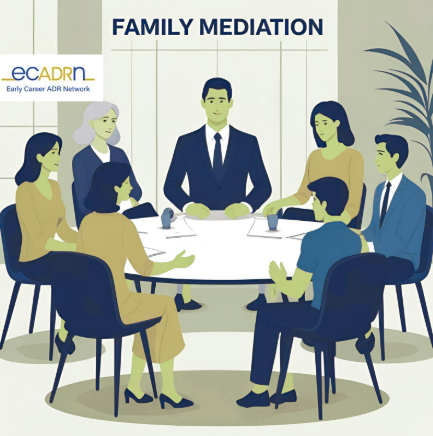
Family mediation is a specialized practice within the broader field of alternative dispute resolution (ADR), where trained professionals assist individuals and families in resolving interpersonal conflicts outside the courtroom. The process most often applies in cases of separation, divorce, or co-parenting and focuses on reaching agreements around parenting arrangements, financial support, and property division. Family mediators serve as neutral third parties who facilitate structured, confidential conversations. Their role is not to make decisions but to assist participants in reaching mutually acceptable solutions (Parkinson 16).
Professionals entering family mediation often come from law, psychology, social work, counseling, or related fields. The educational path usually starts with a university degree, followed by specialized mediation training.
Most family mediation programs include 40 to 80 hours of instruction on mediation theory, family law, domestic violence screening, ethics, and child welfare. Many programs also require practical experience, such as supervised sessions or role-play exercises, to earn certification or accreditation.
Regulations vary by region. In the United Kingdom, the Family Mediation Council oversees accreditation. In the United States, standards are set by individual states and court systems (Robinson and Moloney 128).
Family mediators work in many settings—courts, community organizations, private practice, and online platforms. Their main responsibilities include conducting intake assessments, managing mediation sessions, and helping parties draft memoranda of understanding. Mediators must also decide if a case is suitable for mediation, especially when domestic violence, coercion, or large power imbalances may be present (Bagshaw et al. 95).
Strong mediators show skills such as active listening, conflict de-escalation, emotional regulation, and neutrality, along with an understanding of both legal and psychological issues.
The profession continues to expand as technology and society evolve. Online mediation has improved access for families, while new models support hybrid or remote practice. There is also growing focus on cultural responsiveness and inclusive approaches, especially with Indigenous, immigrant, and multilingual families.
Another growing area is child-inclusive mediation, which allows children to share their perspectives in a safe, structured way. This approach aligns with Article 12 of the United Nations Convention on the Rights of the Child (Robinson and Moloney 130; Toker and Avgar 85).
Family mediation provides a structured, non-adversarial alternative to court. Although it presents emotional and procedural challenges, it continues to create new opportunities for professionals who value constructive conflict resolution and family well-being.

Labor arbitration is a form of alternative dispute resolution (ADR) used to settle workplace disputes that arise under collective bargaining agreements. It often covers issues such as discipline, contract interpretation, wages, working conditions, and dismissals. Instead of going to court, labor arbitration allows a neutral arbitrator to make a binding decision, which often provides a faster and more tailored outcome (American Arbitration Association).
The process usually begins when a union files a grievance under a collective bargaining agreement. If the issue is not resolved through earlier steps, it proceeds to arbitration. An arbitrator—typically chosen from a joint union-management panel—reviews evidence, hears testimony, and issues a written decision. Organizations such as the American Arbitration Association (AAA) and JAMS manage these cases under standard labor arbitration rules to ensure neutrality, timeliness, and fairness (AAA; JAMS).
Labor arbitration focuses on the unique context of labor relations. Arbitrators have expertise in interpreting collective bargaining agreements and labor law. These cases usually move faster than court proceedings, which helps reduce workplace disruptions. They are also less expensive and remain confidential (AAA). However, unlike mediation, arbitration results in a binding decision that can only be challenged in limited circumstances under the Federal Arbitration Act.
Labor arbitration developed alongside labor unions and collective bargaining in the early 20th century. It remains central to labor–management relations today, supported by laws such as the National Labor-Management Relations Act and organizations like the Federal Mediation and Conciliation Service (FMCS) and the National Academy of Arbitrators (NAA) (FMCS; NAA).
Although labor arbitration provides stability and fairness, some critics say it can be rigid and offers limited appeal options. Still, for most organizations and employees, it remains a trusted and effective way to resolve workplace conflicts without going to court.
Employment arbitration is a way to resolve workplace disputes outside of court. It is often used for issues like wrongful termination, unpaid wages, harassment, or discrimination. In arbitration, a neutral person—called an arbitrator—listens to both sides, reviews the evidence, and makes a final decision. Unlike mediation, which focuses on helping both sides agree, arbitration works more like a private trial that ends with a binding ruling (American Arbitration Association).
The process usually starts when both sides agree to arbitration. This can happen voluntarily or through an arbitration clause in a job contract. These clauses are often found in applications, handbooks, or employment agreements. Once a dispute arises, the parties select an arbitrator—either by agreement or from a panel list—and set a hearing date. During the hearing, both sides present their case through documents, witnesses, and testimony. The arbitrator then issues a written decision, called an award, which is legally binding under the Federal Arbitration Act (Sack).
Supporters say employment arbitration is faster, cheaper, and more private than going to court. It can also reduce the courts’ workload and help maintain workplace relationships. However, critics worry about fairness—especially with mandatory arbitration. Some say it gives employers an advantage, limits employee rights, and hides systemic issues from public view (National Employment Law Project).
Rules for employment arbitration depend on the provider (like AAA or JAMS) and the state. Some states have passed laws limiting arbitration in cases involving harassment or discrimination. Even so, arbitration remains common and continues to evolve with workplace law and policy (JAMS).
In short, employment arbitration is widely used but sometimes controversial. It can be efficient and confidential, but it also raises fairness concerns when it is required by employers.
For anyone entering the field of Alternative Dispute Resolution (ADR), technical skills like neutrality, active listening, and understanding the law or policy are essential—but they aren’t enough. To build a meaningful and sustainable career, especially as an independent or private neutral, two core concepts stand out: visibility and acceptability.
These ideas go beyond professional buzzwords. They determine whether you are noticed, trusted, and ultimately hired.