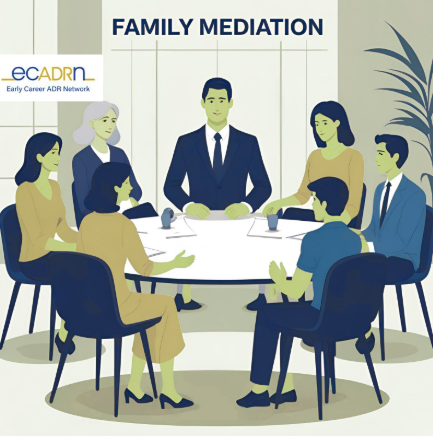
Family Mediation
Family mediation is a specialized practice within the broader field of alternative dispute resolution (ADR), where trained professionals assist individuals and families in resolving interpersonal conflicts outside the courtroom. The process most often applies in cases of separation, divorce, or co-parenting and focuses on reaching agreements around parenting arrangements, financial support, and property division. Family mediators serve as neutral third parties who facilitate structured, confidential conversations. Their role is not to make decisions but to assist participants in reaching mutually acceptable solutions (Parkinson 16).
Professionals entering family mediation often come from law, psychology, social work, counseling, or related fields. The educational path usually starts with a university degree, followed by specialized mediation training.
Most family mediation programs include 40 to 80 hours of instruction on mediation theory, family law, domestic violence screening, ethics, and child welfare. Many programs also require practical experience, such as supervised sessions or role-play exercises, to earn certification or accreditation.
Regulations vary by region. In the United Kingdom, the Family Mediation Council oversees accreditation. In the United States, standards are set by individual states and court systems (Robinson and Moloney 128).
Family mediators work in many settings—courts, community organizations, private practice, and online platforms. Their main responsibilities include conducting intake assessments, managing mediation sessions, and helping parties draft memoranda of understanding. Mediators must also decide if a case is suitable for mediation, especially when domestic violence, coercion, or large power imbalances may be present (Bagshaw et al. 95).
Strong mediators show skills such as active listening, conflict de-escalation, emotional regulation, and neutrality, along with an understanding of both legal and psychological issues.
The profession continues to expand as technology and society evolve. Online mediation has improved access for families, while new models support hybrid or remote practice. There is also growing focus on cultural responsiveness and inclusive approaches, especially with Indigenous, immigrant, and multilingual families.
Another growing area is child-inclusive mediation, which allows children to share their perspectives in a safe, structured way. This approach aligns with Article 12 of the United Nations Convention on the Rights of the Child (Robinson and Moloney 130; Toker and Avgar 85).
Family mediation provides a structured, non-adversarial alternative to court. Although it presents emotional and procedural challenges, it continues to create new opportunities for professionals who value constructive conflict resolution and family well-being.